
Selected work
holdON on canvas
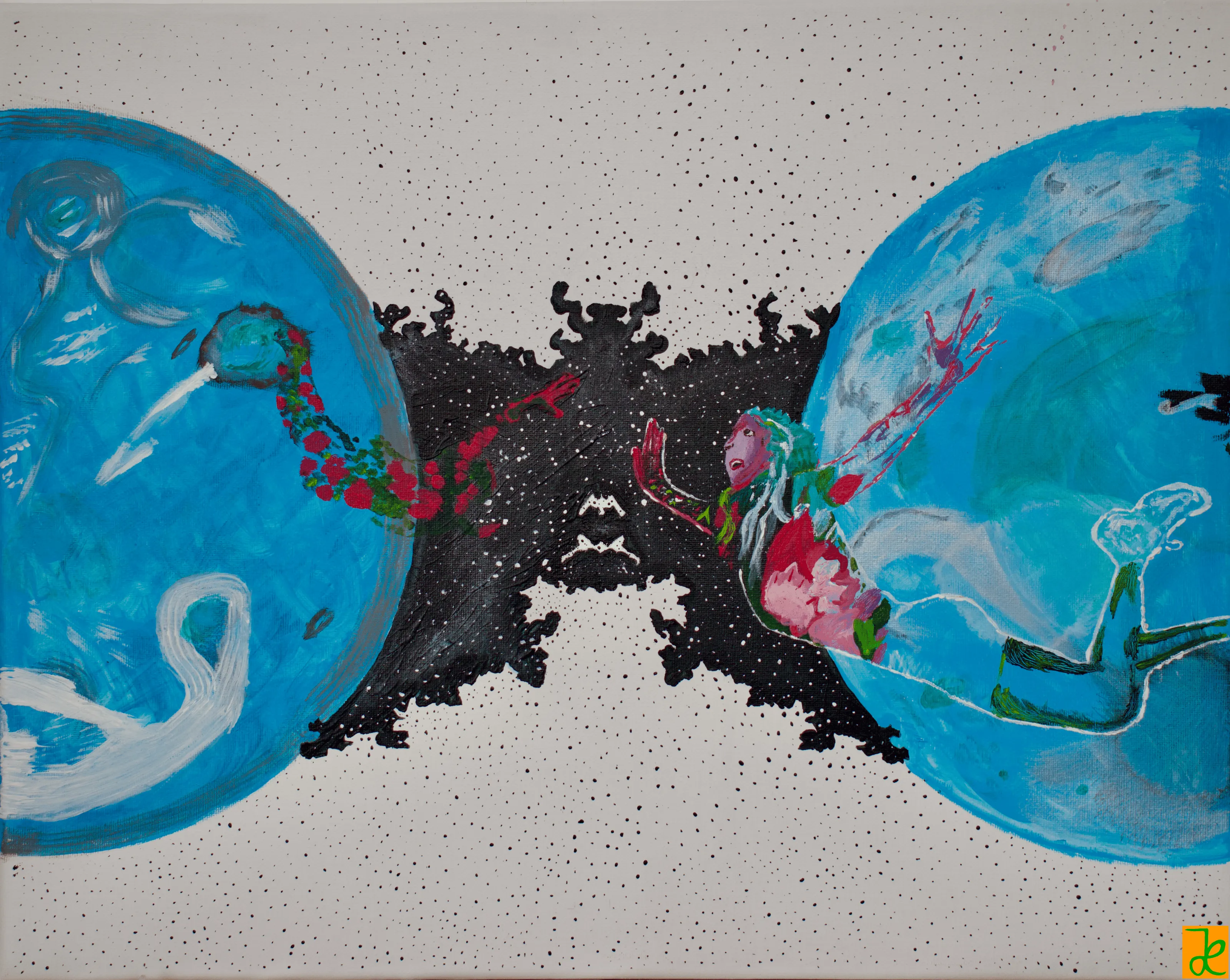
holdON transfers the earlier digital constellation into a more open, painterly condensed scene of relation.
Brief description
holdON transfers the earlier digital constellation into a more open, painterly condensed scene of relation. Once again, two bodies face one another, and their approach is marked by distance and uncertainty; however, the pictorial order is now reduced and more physical. A fragile connecting line and an ambiguous dark form organise the image as a threshold space between isolation and contact. The centre remains ambivalent: it can be read as a projection surface for expectation, threat or fear, holding the figures apart while also keeping them in relation. Freedom appears here not as detachment, but as negotiation—between protection and exposure, inside and outside, approach and possible loss.
Materiality and process
The work is executed in acrylic on canvas and develops its tension through painterly placement, spatial arrangement and deliberate reduction. The planetary forms are no longer digitally assembled but treated as painterly bodies that hold the figures at the margins and structure the space between them. The fragile connecting line does not form a secure bond, but a precarious orientation within an unstable field. The dark dots are applied in acrylic with a toothpick; they create a tactile, vulnerable trace that condenses the central form without defining it conclusively. This marks the difference from the 2017 version: where digital artefacts, noise and edges once made the connection visible as disruption, the same problem is now slowed down and condensed through painterly means. The threshold no longer appears as a glitch-like interruption, but as a materially and spatially constructed zone of uncertainty.
References
Medium/tools: canvas; acrylic; toothpick
Technique: analogue painting; spatial placement of colour fields and figures; dotted structure in acrylic
Concise development: Between 2017 and 2024, holdON shifts from a digitally constructed, visibly disrupted connection to a painterly concentrated threshold structure. The early version develops relation through montage, noise, reflection and artefact—connection appears as a precarious leap through a technically and visually charged intermediate space. The later canvas work adopts this basic structure but reduces it to a few spatially active elements: sphere, figure, line and dark centre. The pictorial idea becomes quieter, but not simpler. The disruption does not disappear; it moves from the digital rupture into the material and psychological contradiction of the painted space.